


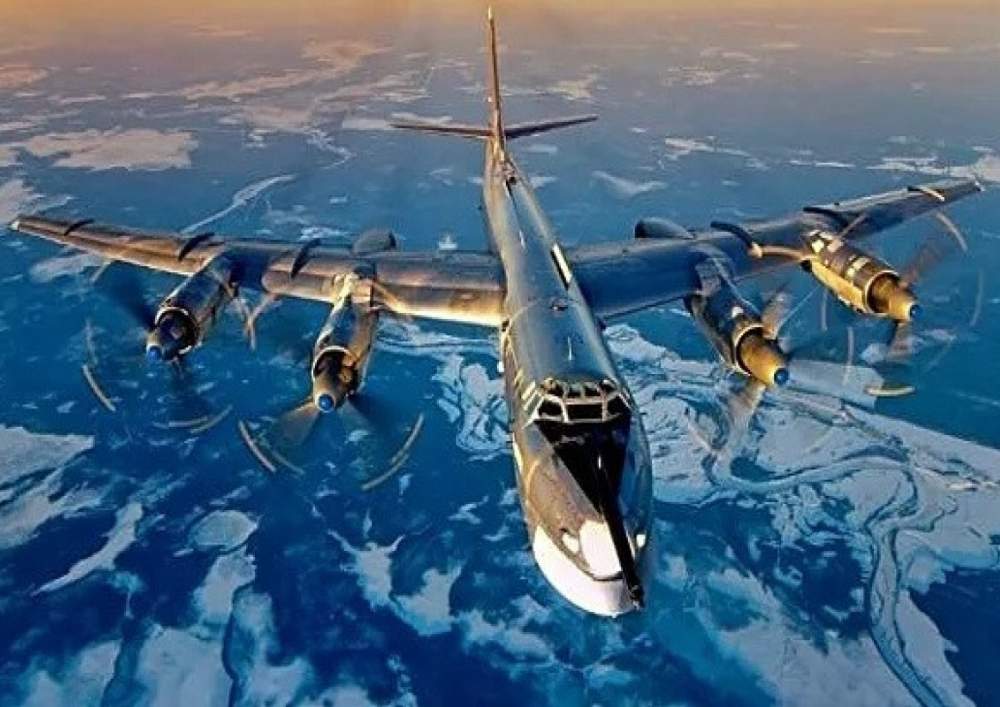
Tokyo – In a striking display of military coordination, Russian strategic bombers joined Chinese warplanes on a joint patrol near Japanese waters, prompting Japanese defence forces to scramble jets in response. The manoeuvre comes at a time of increasing friction between Tokyo and Beijing and has raised concerns about security and stability in the Asia-Pacific region.
The operation involved two Russian Tu‑95 bombers taking off from the Sea of Japan and linking up with two Chinese H‑6 bombers for a long-range patrol. Four Chinese J‑16 fighter jets escorted the aircraft on a round-trip flight between Okinawa and Miyako islands, passing through the strategic Miyako Strait in international waters.
Simultaneously, Japanese radar detected additional Russian air activity, including a Beriev A‑50 early-warning aircraft accompanied by two Su‑30 fighters over the Sea of Japan. Moscow reported that the joint mission lasted approximately eight hours, highlighting the extensive scope of the patrol.
Japanese Defence Minister Shinjiro Koizumi condemned the patrol, describing it as “a clear show of force aimed at our nation” and warning that such actions pose a serious threat to regional security. The Self-Defense Forces scrambled fighter jets to carry out air-defence identification measures in response to the incursion.
Analysts note that this joint Chinese-Russian operation reflects deeper military cooperation between Moscow and Beijing, potentially aimed at counterbalancing Western alliances and signalling a shift in regional power dynamics. The patrol also comes after several incidents in which Chinese jets locked radar on Japanese aircraft near Okinawa, which Tokyo called “dangerous and provocative.”
Experts warn that if these joint patrols become more frequent, neighbouring countries, including Japan and South Korea, may feel compelled to boost defence readiness. This could trigger a new cycle of military escalation in the region, making the Asia-Pacific’s airspace and waters increasingly tense and unpredictable.
The latest developments underscore the growing complexity of regional security, where strategic signalling by Russia and China intersects with Japan’s efforts to protect its territory and maintain stability in international waters. Observers say the coming months will be critical in determining whether diplomatic channels can prevent further escalation or if the region faces a prolonged period of heightened military activity.
This story has been reported by PakTribune. All rights reserved.